THIS IS AN ASPIRE PHARMA WEBSITE PAGE INTENDED FOR UK PATIENTS WHO HAVE BEEN PRESCRIBED GATALIN XL® (GALANTAMINE)
Gatalin XL® (galantamine)
Prolonged-release capsules

About Gatalin XL®
Summary of Product Characteristics (SmPC) and Patient Information Leaflet (PIL)
The following links will take you to the electronic Medicines Compendium (eMC) website.
By using the links below, you will leave the Pathway Portfolio website and be re-directed to an external site. Aspire Pharma is not responsible for the content on external websites.
1
2
3
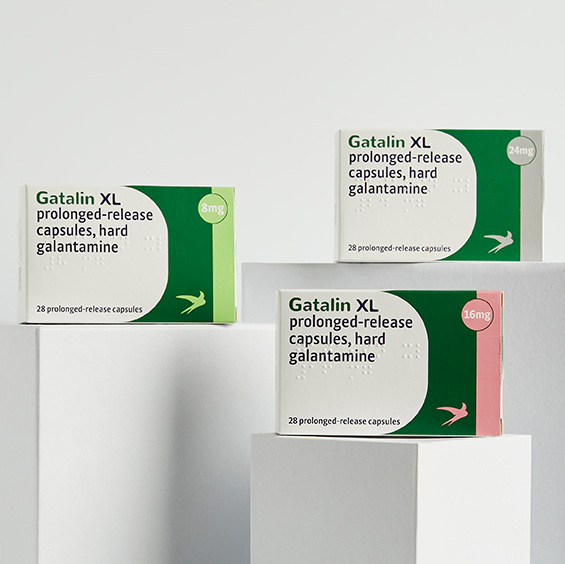
1
Gatalin XL 8mg
2
Gatalin XL 16mg
3
Gatalin XL 24mg
What is Alzheimer’s Disease?
Definition
Dementia is a syndrome (a group of related symptoms) associated with an ongoing decline of brain functioning. It can affect memory, thinking skills and other mental abilities.1 The causes of Alzheimer’s disease are very complex, but one important factor is the build-up of two proteins in the brain called amyloid and tau. When the conditions in the brain change, these proteins can clump together and form tiny structures known as plaques and tangles. These interfere with normal brain function, making it harder for the brain to work properly.2
Alzheimer’s is a progressive disease. This means that gradually, over time, more parts of the brain are damaged. As this happens, more symptoms develop, and they also get worse.2
Alzheimer’s disease is the most common cause of dementia in the UK.1
Stages of Alzheimer’s disease
Generally, the symptoms of Alzheimer’s disease are divided into 3 main stages.3
Early symptoms
In the early stages, the main symptom of Alzheimer’s disease is memory lapses.
For example, someone with early Alzheimer’s disease may:
- forget about recent conversations or events
- misplace items
- forget the names of places and objects
- have trouble thinking of the right word
- ask questions repetitively
- show poor judgement or find it harder to make decisions
- become less flexible and more hesitant to try new things
There are often signs of mood changes, such as increasing anxiety or agitation, or periods of confusion.
Middle-stage symptoms
As Alzheimer’s disease develops, memory problems will get worse.
Someone with the condition may find it increasingly difficult to remember the names of people they know and may struggle to recognise their family and friends.
Other symptoms may also develop, such as:
- increasing confusion and disorientation – for example, getting lost, or wandering and not knowing what time of day it is
- obsessive, repetitive or impulsive behaviour
- delusions (believing things that are untrue) or feeling paranoid and suspicious about carers or family members
- problems with speech or language (aphasia)
- disturbed sleep
- changes in mood, such as frequent mood swings, depression and feeling increasingly anxious, frustrated or agitated
- difficulty performing spatial tasks, such as judging distances
- seeing or hearing things that other people do not (hallucinations)
Later symptoms
In the later stages of Alzheimer’s disease, the symptoms become increasingly severe and can be distressing for the person with the condition, as well as their carers, friends and family.
Hallucinations and delusions may come and go over the course of the illness, but can get worse as the condition progresses.
People living with Alzheimer’s disease may also experience changes in their behaviour. For example, they may become angry or aggressive, such as shouting or hitting out, feel distressed, anxious or restless, or call out or repeat the same question or phrase many times.
A number of other symptoms may also develop as Alzheimer’s disease progresses, such as:
- difficulty eating and swallowing (dysphagia)
- difficulty changing position or moving around without assistance
- weight loss – sometimes severe
- unintentional passing of urine (urinary incontinence) or stools (bowel incontinence)
- gradual loss of speech
- significant problems with short- and long-term memory
Risk Factors
Although the exact triggers of Alzheimer’s disease are not fully understood, several factors are known to increase the risk of developing the condition. These include increasing age, family history, Down’s syndrome, previous head injuries, and conditions that affect heart and blood vessel health, such as high blood pressure, diabetes, and high cholesterol.4
Resources
By using the link below you will leave the Pathway Portfolio website and be re-directed to an external site; Aspire Pharma is not responsible for the content on external websites.



References:
- NHS: Alzheimer’s Disease. https://www.nhs.uk/conditions/alzheimers-disease/ (Accessed June 2026)
- Alzheimer’s Society: What is Alzheimer’s Disease? https://www.alzheimers.org.uk/info/20007/types_of_dementia/2/alzheimers_disease (Accessed June 2026)
- NHS: Symptoms of Alzheimer’s Disease. https://www.nhs.uk/conditions/alzheimers-disease/symptoms/ (Accessed June 2026)
- NHS: Causes of Alzheimer’s Disease. https://www.nhs.uk/conditions/alzheimers-disease/causes/ (Accessed June 2026)
MAT-UK-XLP-0052-1 | June 2026
